 Corridor Observatory
Corridor Observatory
A scalable, collaborative model for long-term ecological monitoring within the Florida Wildlife Corridor
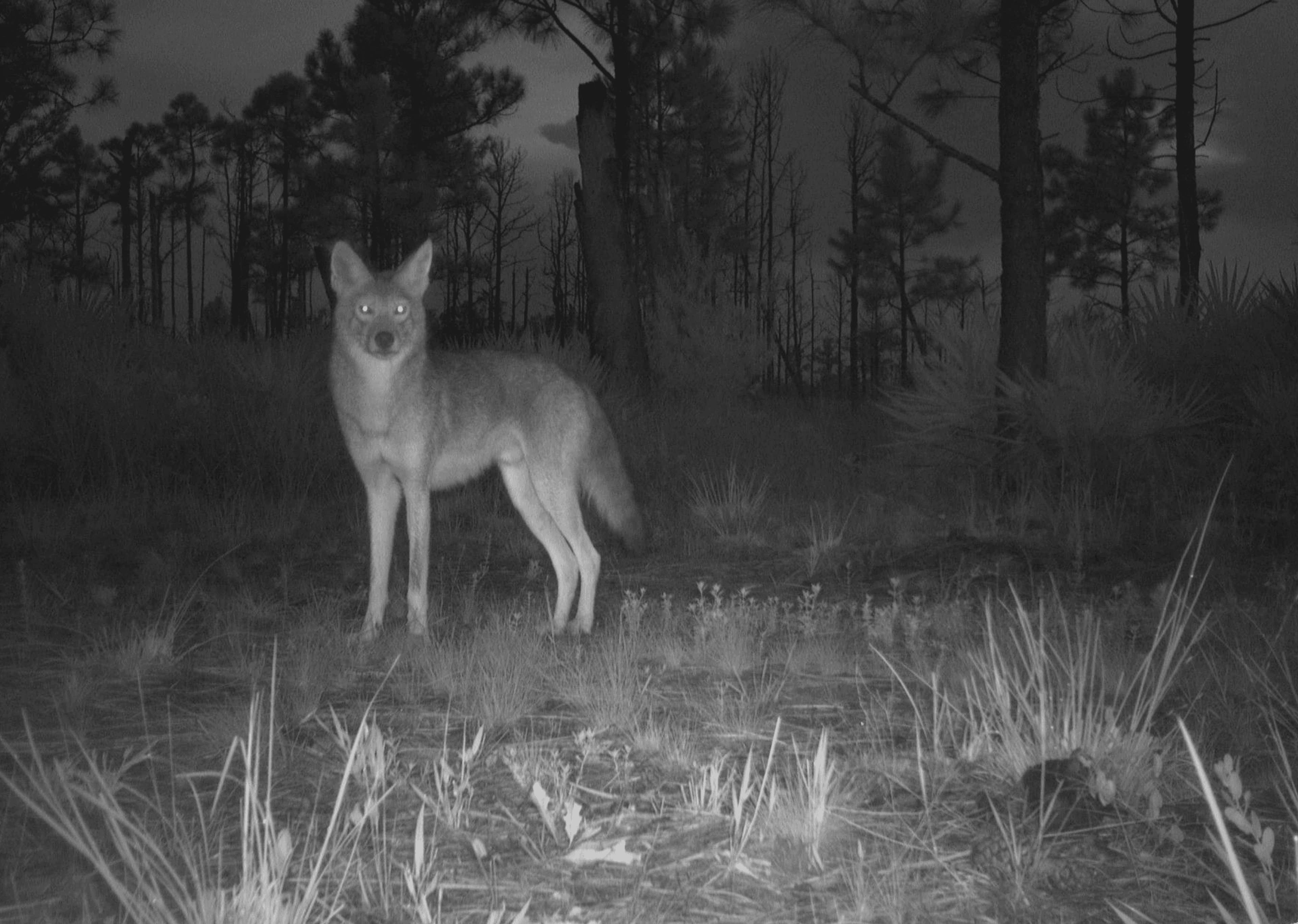
The Corridor Observatory is a long-term, collaborative biodiversity monitoring network designed to evaluate how wildlife communities respond to land use, land management, and conservation efforts within the Florida Wildlife Corridor. As part of Archbold’s long-term scientific infrastructure, the Observatory is comprised of a standardized 1 km x 1 km grid of camera traps and autonomous recording units (ARUs) deployed across working ranches, citrus groves, conserved lands, and areas on the rural-urban fringe. This network provides a stream of wildlife detection to support ecological analysis and inform decision-making. The Corridor Observatory is made possible through the collaboration of multiple research institutions to build a scalable model for ecological monitoring.
Major Findings & Impact
Using three years of continuous camera trap data, we have found habitat type and season to be stronger predictors of wildlife occupancy than cattle density on a subtropical Florida ranch. Species-level and community-level occupancy are significantly higher in semi-native pastures than in improved pastures, and occupancy declined during the winter dry season across all three years. Cattle density has not been found to significantly influence wildlife occupancy. Our findings suggest ranchlands provide habitat value for wildlife broadly and remain compatible for wildlife corridor conservation when vegetative cover and structural complexity are maintained through pasture management.
Project Details
More about this project
Primary Location(s)
DeLuca Preserve, Archbold Biological Station, Buck Island Ranch, Lake Wales Ridge, Headwaters of the Everglades Watershed, Florida Wildlife Corridor
Years Active
2022 - Present
Data and Analysis Types
Occupancy studies, distribution and abundance for several species of terrestrial and semi-terrestrial birds and mammals
Related People
Funders & Collaborators
UF/IFAS Range Cattle Research & Education Center (RCREC): Dr. Hance Ellington at RCREC collaborates in the design, field deployment, and scientific analysis of Corridor Observatory monitoring arrays across working ranchlands. University of Florida researchers bring field and technical expertise to our work, recruit and mentor graduate students, and applied research linking wildlife communities to agricultural landscapes.
Environmental Data Science Innovation & Impact Lab (ESIIL), University of Colorado-Boulder: Our Corridor Observatory collaboration is powered in large part through ESIIL, which provides critical infrastructure for large-scale data processing, storage and reproducible analysis. The Observatory’s image and acoustic data are developed, standardized, and published through collaboration with ESIIL’s environmental data science community.
USDA-APHIS & USDA-ARS Research Units: Collaborations with USDA research units support the development, benchmarking and evaluation of machine learning tools used to classify wildlife images. These partnerships allow the Observatory to rigorously test AI applications in real-world ecological monitoring contexts, strengthening conservation outcomes and providing cost-saving solutions for land managers in working landscapes like that of the Everglades Headwaters region.